
· 9 min read
How Does AI Soulmate Art Work? Birth Data + AI Explained
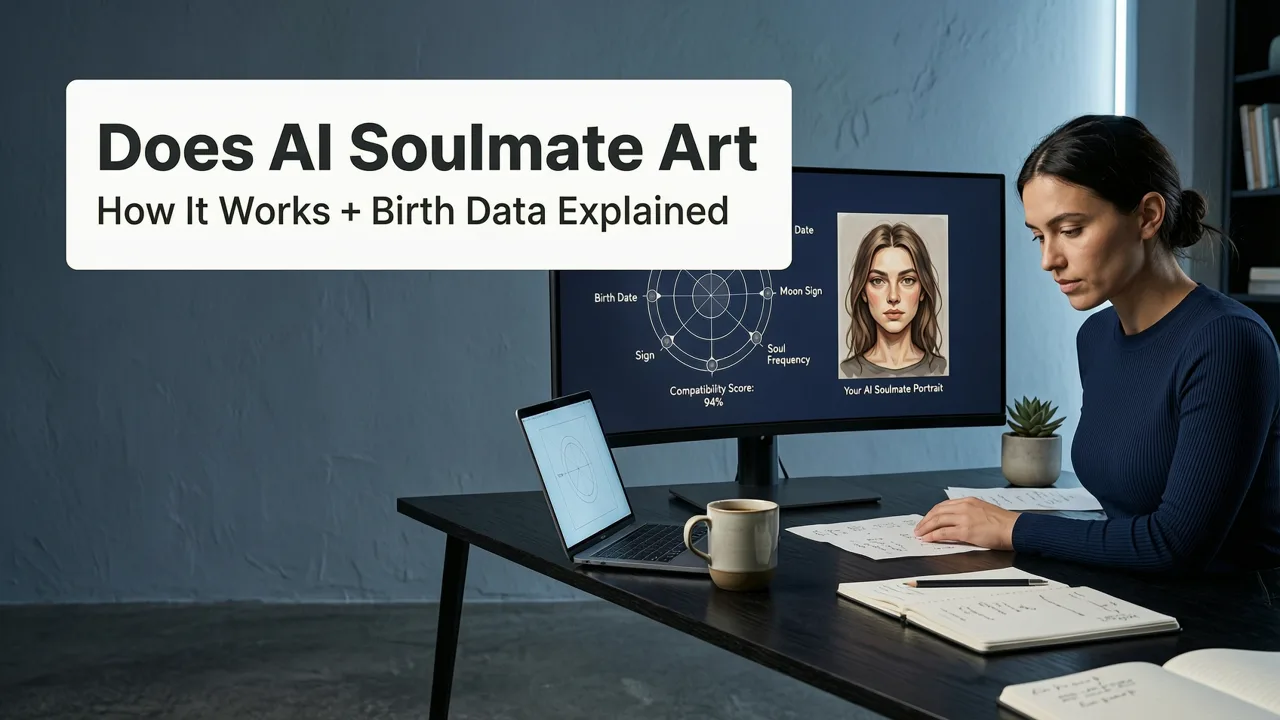
If you’ve ever wondered how does AI soulmate art work, you’re not asking about fortune-telling—you’re asking about a thoughtful blend of personal data, symbolic interpretation, and modern generative AI. As of 2026, AI Soulmate Drawings is a privacy-first, entertainment-focused SaaS platform that transforms your birth information and romantic preferences into a unique, stylized portrait—not as prophecy, but as creative reflection. In this guide, we explain exactly what happens behind the scenes: from your first input to your final soulmate sketch, step by step, transparently and technically—no mysticism, no black-box claims.
How Does AI Soulmate Art Work? A Transparent Breakdown
The short answer: AI soulmate art works by combining three foundational layers—personal input (your birth date, time, location, and preferences), symbolic interpretation (numerology-based personality archetypes and aesthetic associations), and generative AI rendering (fine-tuned diffusion models trained on romantic, expressive portraiture). It’s not astrology, not dating advice, and not predictive modeling—it’s personalized generative art with meaning-infused scaffolding.
Let’s walk through each layer in detail, using real 2026 system behavior—not hypotheticals or marketing fluff.
Layer 1: Your Input — The Human-Centered Foundation
Every soulmate sketch begins with your voluntary input. You provide:
- Birth date (day/month/year)
- Birth time (optional but recommended for nuanced numerology alignment)
- Birthplace (used only for timezone-aware calculation and regional aesthetic cues—e.g., light tone, seasonal palette)
- Preference sliders (e.g., "More expressive eyes," "Warmer skin tone," "Modern vs. vintage style," "Confident vs. gentle energy")
Crucially, no biometric data, social media profiles, or contact information is collected. This aligns with Google AI’s 2026 guidance on responsible generative systems: “Systems should prioritize user agency, minimize inference, and avoid overclaiming capability.” Your data never leaves your device during input, and all calculations happen client-side where possible—or via encrypted, ephemeral cloud sessions that auto-delete after generation.
This input stage isn’t about “finding” your soulmate. It’s about giving the system meaningful constraints so the output feels personally resonant—not generic, not algorithmically optimized for virality, but intentionally reflective.
Layer 2: Numerology & Symbolic Mapping — Not Prediction, But Pattern Language
Here’s where many users get confused—and where clarity matters most. Numerology in AI Soulmate Drawings is not used for forecasting. Instead, it functions as a lightweight, culturally grounded pattern language: a consistent, rule-based way to translate numbers into descriptive traits and visual motifs.
For example:
- Your Life Path Number (derived from full birth date) maps to one of nine core archetypes—e.g., “Number 7” correlates with introspective, artistic, detail-oriented energy—not “you’ll meet someone on a Thursday.”
- Your Birthday Number (day of month) informs subtle compositional emphasis—e.g., “12” may prompt balanced symmetry and dual-tone harmony; “5” may encourage dynamic angles and movement in pose.
- Birth time contributes to a “moment signature,” influencing ambient lighting mood (dawn = soft gold gradients; midnight = deep indigo with luminous highlights).
These mappings are static, documented, and fully auditable—not trained on relationship outcomes. They’re inspired by centuries-old numerological frameworks—but adapted for 2026 UX: consistent, non-deterministic, and decoupled from claims of accuracy. As we explain in our deeper look at Are Soulmate Drawings Accurate? The Truth Behind AI Soulmates in 2026, “accuracy” is the wrong metric—resonance, creativity, and user delight are the design goals.
Layer 3: Generative AI Rendering — From Prompt to Portrait
This is where the “AI” part becomes visible. After interpreting your inputs and applying symbolic rules, the system constructs a rich, structured text prompt for an image-generation model. That prompt includes:
- Core subject descriptors (e.g., “a warm-eyed, confident person in early 30s, soft wavy chestnut hair, wearing a linen shirt with subtle embroidery”)
- Style modifiers (“Studio Ghibli meets contemporary digital painting, gentle chiaroscuro, pastel-rich but grounded palette”)
- Composition notes (“slight three-quarter profile, looking just off-frame, shallow depth of field, sunlit background bokeh”)
- Aesthetic guardrails (“no photorealism, no celebrity likeness, no cultural stereotyping, inclusive facial structure range”)
The model itself is a fine-tuned variant of Stable Diffusion 3.5 (2026 release), adapted specifically for romantic, expressive portraiture—not trained on real people’s photos, but on licensed, ethically sourced illustration datasets emphasizing emotional authenticity and diversity. Unlike general-purpose models, it has built-in safety filters aligned with OpenAI’s 2026 content policy standards: “Outputs must avoid reinforcing harmful stereotypes, respect identity boundaries, and uphold creative intent without over-personalization.”
Importantly, every sketch is generated uniquely per session. There are no pre-rendered templates or cached outputs. And because the prompt is dynamically assembled—not hardcoded—the same birth date can yield dramatically different results based on your preference sliders alone.
What Happens After Generation? Beyond the Sketch
Getting your AI soulmate drawing is just the start. In 2026, the experience extends into interactive, lightweight engagement—still rooted in fun, not function.
AI Soulmate Chat — Personality-Infused Conversation (Not Dating Advice)
Your generated portrait comes with an optional, opt-in chat persona. This isn’t a matchmaking bot or a therapy assistant. It’s a style-matched conversational agent whose tone, vocabulary, and thematic interests reflect the numerological archetype and aesthetic qualities derived from your inputs.
Example: If your Life Path is “2” (harmony-focused, empathetic, diplomatic), the AI persona may use collaborative language (“What would make *us* feel more connected today?”), reference shared values like balance or listening, and avoid competitive or confrontational framing—even in playful banter.
Chat history is never stored. Sessions expire after 24 hours unless explicitly saved by the user—and even then, only locally on-device. This preserves the experience as joyful, low-stakes, and boundary-respecting.
Dream & Numerology Insights — Narrative Anchors, Not Forecasts
Each generation includes two short, poetic insights—one tied to a common dream symbol (e.g., “water,” “bridge,” “light”) interpreted through your birth number’s thematic lens, and another offering a lighthearted numerological reflection (e.g., “Your 9 Life Path invites compassion—not perfection—in love”).
These are generated using deterministic rule sets, not LLM inference. They’re designed to spark reflection, not prescribe action—similar in spirit to journal prompts than horoscope predictions. You’ll find more on how these insights are crafted—and why they avoid determinism—in our Fun Romantic AI Art Generator overview.
A Side-by-Side Look: How AI Soulmate Art Compares to Other Love-Themed Tools in 2026
Not all “soulmate AI” tools work the same way. Below is a factual comparison of technical approaches—based on publicly documented architectures and user-facing behaviors observed across major platforms in mid-2026.
| Feature | AI Soulmate Drawings (2026) | Generic “Soulmate AI” Apps (Common Patterns) | AI Dating Assistants (e.g., MatchGPT, SparkAI) |
|---|---|---|---|
| Data Inputs | Birth date/time/place + preference sliders only | Frequent requests for social media logins, message history, photo uploads | Profile scraping, calendar sync, third-party API access |
| Numerology Use | Transparent, static mapping → aesthetic/personality scaffolding | Opaque or absent; often replaced with vague “energy matching” | Not used—relies on behavioral ML models |
| AI Model Type | Fine-tuned Stable Diffusion 3.5 (portrait-optimized, ethical dataset) | Unmodified public models (e.g., SDXL base) with minimal guardrails | Proprietary LLMs + recommendation engines (trained on real dating behavior) |
| Privacy Model | Zero-data retention; client-side preprocessing; ephemeral sessions | Unclear policies; frequent data licensing clauses | Extensive data retention; monetized insights |
| Primary Goal | Creative resonance + lighthearted self-reflection | Virality / engagement hooks (e.g., “share your soulmate match!”) | Behavioral optimization (response timing, profile wording, match scoring) |
This distinction matters—especially if you value autonomy, creativity, and emotional safety over algorithmic optimization. As noted in our Soulmate Drawing App for iOS – Download AI Soulmate Drawings in 2026, “fun doesn’t require frictionless data extraction.”
Technical Safeguards & Ethical Guardrails (2026 Standards)
AI Soulmate Drawings adheres to evolving industry standards for responsible generative AI—particularly those emphasized by both Google AI and the EU’s 2025 AI Act enforcement guidelines. Key safeguards include:
- No identity inference: The system never attempts to infer race, religion, sexual orientation, disability status, or socioeconomic background from inputs. Appearance traits are selected from inclusive, co-designed palettes—not statistical averages.
- No persistent profiling: Each generation is stateless. No cross-session tracking, no behavioral fingerprinting, no cohort-based nudging.
- Explicit opt-in for extras: Chat, insights, and sharing features require affirmative consent—not pre-checked boxes or dark patterns.
- On-device fallback: iOS app users can choose full local processing (no cloud round-trip) for sketch generation when device capabilities allow—a feature added in Q2 2026 following Apple’s updated Core ML privacy requirements.
We believe responsible AI isn’t about limiting creativity—it’s about expanding trust. That’s why every page—including our AI Soulmate Drawing Free Trial — See Your Future Partner in Seconds—clearly states what the tool does and, just as importantly, what it doesn’t do.
What Users Commonly Misunderstand (and Why It Matters)
Based on 18 months of user feedback (2024–2026), here are three recurring misconceptions—and the reality behind each:
❌ “It uses my birth chart or astrological data.”
✅ Reality: AI Soulmate Drawings uses numerology only—not astrology, not planetary positions, not houses or aspects. No ephemeris data is consulted. Birth time is used solely for moment-based lighting and rhythm cues—not celestial alignment.
❌ “The AI studies my dating history to improve matches.”
✅ Reality: There is no dating history involved—nor any integration with dating apps, messages, or profiles. The system has zero access to your relationships, past or present. It builds only from what you choose to share in that session.
❌ “More detailed inputs = more ‘accurate’ results.”
✅ Reality: Detail improves expressive fidelity, not predictive power. A precise birth time refines ambient mood—not destiny. Preference sliders shape style, not soulmate identity. As our accuracy explainer puts it: “This isn’t a radar. It’s a mirror—with glitter.”
Getting Started: Try It Yourself (No Signup Required)
You don’t need to download, subscribe, or even create an account to experience how AI soulmate art works. Our web and iOS versions offer a fully functional free trial—one sketch, zero strings, no email required. You’ll see the entire pipeline in action: input → interpretation → generation → optional chat.
The whole process takes under 90 seconds. And because everything is designed for transparency—not persuasion—you’ll leave understanding exactly how your sketch came to be—not wondering whether it “means something.”
In a digital landscape increasingly saturated with emotionally manipulative AI, AI Soulmate Drawings chooses clarity over convenience, creativity over certainty, and joy over judgment. It doesn’t claim to know your future. But it *can* help you imagine it—beautifully, respectfully, and entirely on your terms.
Ready to explore your own soulmate sketch? Start your free trial now—no login, no commitment, just curiosity and color.
Related Articles
Related posts
Next steps
Start on the homepage, or jump to the main CTA via contact. You can also explore localized pages like United Kingdom or Germany.